
Super Ace Cards: Golden, Wild and Plain on the Grid
By Super Ace Editorial Team
- 21+ onlyCasino play in the Philippines starts at 21, and every page at this table is written for readers who have reached it. Under 21? Please leave the table now.
- Figures from JILI pagesA max win, a volatility label or a feature rule is printed only when the studio's own game page shows it, or when the sum is worked out in front of you.
- No casino named or rankedNo casino is named, scored or recommended here. The guide deals no cards and keeps no wallets, and no page promises a payout.
Every symbol in this slot is a playing card, which is why the theme reads so easily: you already know the faces. This section sorts the cards on the grid by what they do, then steps back to the ordinary deck so the vocabulary is clear.
The cards that sit on the grid
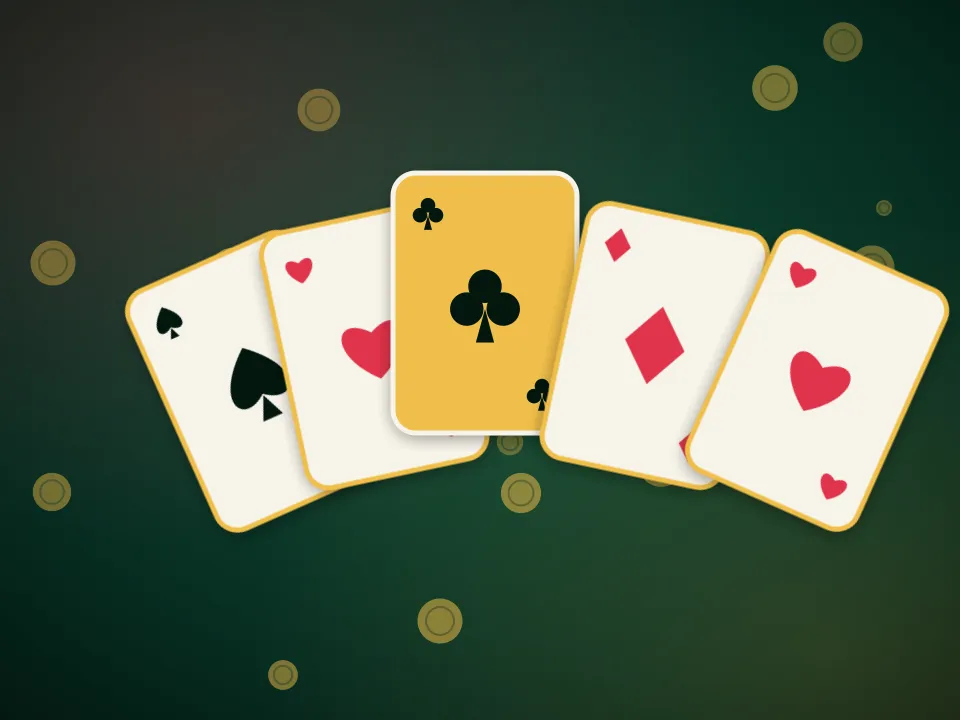
JILI’s game screens show A, K, Q and J faces, spade, heart, club and diamond cards, gold-framed cards, WILD jester cards and a SCATTER coin. Plain cards are the pay bulk, golden ones are the engine, and the wild and scatter are the specials.
| Card on screen | What it does |
|---|---|
| A, K, Q, J faces | Ordinary wins on ways |
| Suit cards | Ordinary wins on ways |
| Golden-framed card | Leaves a Golden Joker when eliminated |
| WILD jester | Stands in for other cards |
| SCATTER coin | Counts toward the Free Game |
One page for each card
The golden card page follows the gold frame through a win, and the Golden joker covers what takes its place. The wild symbol entry explains substitution in general and in the sequels.
For the deck itself, read card suits, card ranks, the ace card meaning and the joker card meaning. The playing cards page shows why a 52-card deck and a reel are different things.
That is 8 entries, 3 for grid cards and 5 for the deck.
That is 8 entries, 3 for grid cards and 5 for the deck.
Example: the grid shows 5 reels by 4 rows, so up to 20 of these cards sit on screen at once.
How the cards work together in one spin
A spin uses all of these at once, so it helps to follow one card through. A plain card lands and pays as part of a run. A golden card in that run is eliminated with it, and a Golden Joker appears in its place. The new wild then helps the next drop complete a longer run, and the ladder climbs one rung with each win.
- Plain cards form a run on neighbouring reels.
- The run clears, golden card included.
- A Golden Joker stands where the golden card was.
- New cards drop, and the wild may join a second run.
- The ladder steps up for each consecutive win.
Counting the grid
The grid has 5 reels by 4 rows, so 20 positions hold cards at any moment. A scatter coin counts anywhere among those 20, while a run needs neighbouring reels. Example: with 20 positions, three scatters can sit in 20 x 19 x 18 ÷ 6 = 1,140 different position sets, which shows how much room a scatter has and says nothing about how often it lands.
What to take from the section
Learn the five cards in the table first, then the deck vocabulary. The deck pages are for reading the theme and the paytable page is for reading the game. For a first look at what the game itself prints, use the order-of-play rules.
Five cards in the table and 8 pages are all JILI’s grid needs.
Where the deck pages fit
The first three pages cover cards that exist only on the grid, and the last five cover the deck they imitate. Read them in either order. A reader who knows cards well can skip the deck and go straight to the golden card, and a newcomer can start with the deck and arrive at the grid with the vocabulary ready.
Example: a newcomer who learns that a deck has 13 ranks in 4 suits can then read a paytable line about a king or a heart without stopping to ask what it is.
Of the 8 pages in this section, 5 are about the real deck and 3 about the JILI grid.
Why the deck is not the reel
A standard deck has 52 cards, 4 suits of 13 ranks, so one card drawn is an ace with probability 4 in 52. A slot reel is not a deck: JILI does not publish how many of each card sit on a reel strip, so those odds cannot be carried over.
Example: in a real deck, 4 ÷ 52 is about 7.7% for an ace on a single draw. On the grid nobody can print an equivalent number, and any site that does is guessing. Read the paytable page for what is and is not shown. For readers aged 21 and over.
Deal it out in three steps
-
Read the card
Find the symbol or rule this page covers and check how the game's own help screen describes it before trusting any other version.
-
Follow the cascade
Watch what a win sets off: which cards clear, what drops into the gaps and how far the multiplier steps before the board settles.
-
Price the payout
Hold what the round can pay against the stake it needs, then fix a peso limit for the session before the first spin.